

latitude = 49°52' North
longitude = 6°10'
altitude = 218 m a.s.l.
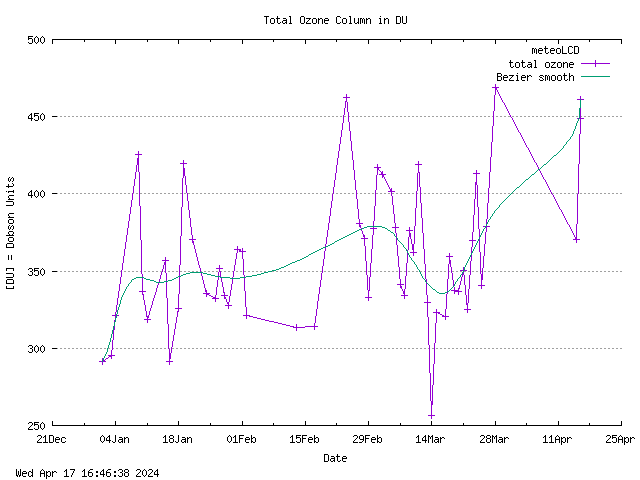 click to enlarge!
| Look here: | 1. Intercomparison between the ozone measurements of the Microtops II and those
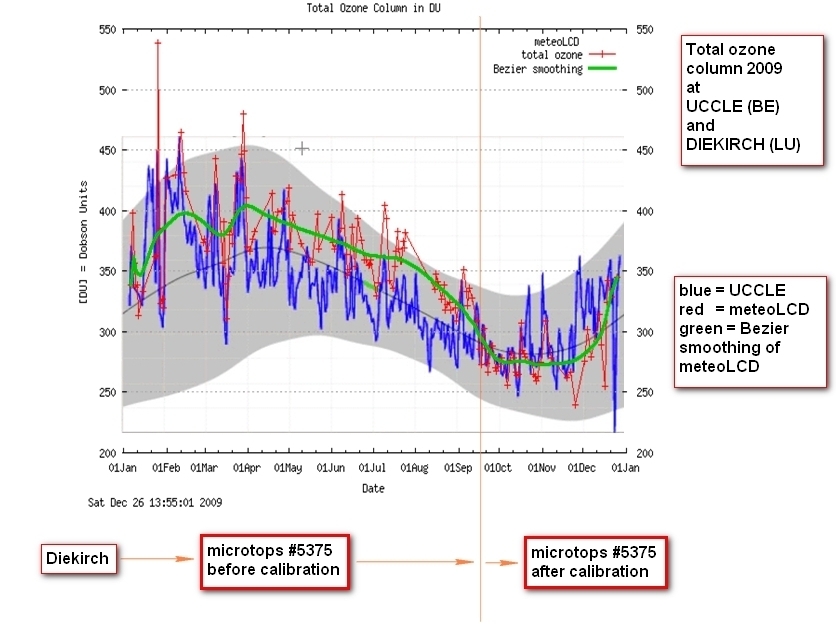
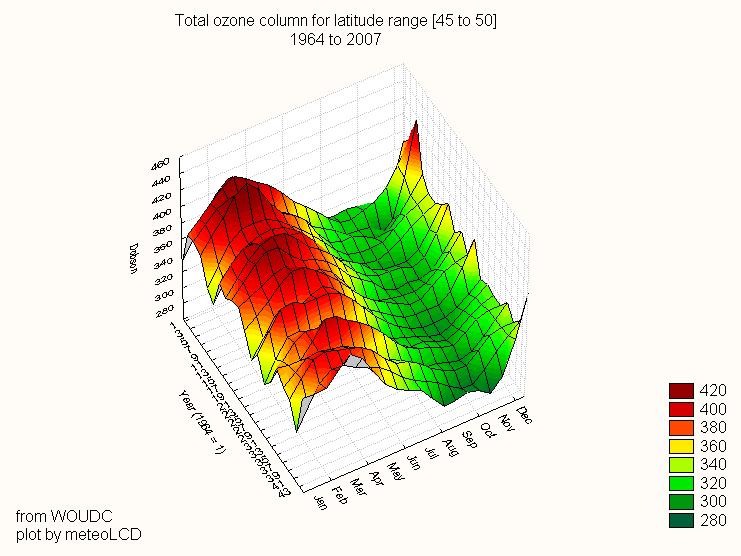
made by the Brewer instrument at the RMI at Uccle and several satellites over the last 8 years. 2. Overplot of 2009 Uccle and meteoLCD total ozone measurements.(new!) 3. 3D plot of total ozone column for latitude region [45 to 50] from 1964 to 2007 and maps of all of meteoLCD measurements (from WOUDC) |
| Thickness of the ozone layer at Uccle | Measured by the Royal Meteorological Institute (RMI) of Belgium; shows mean and variance of all data from 1971 on (link has changed!) |
| Ozone Distribution (NH + SH) | Global Ozone maps from Environment Canada |
| Northern Hemisphere Ozone Map | Ozone map generated from all Northern Hemisphere stations by the WOUDC |
| The coordinates of DIEKIRCH are: latitude = 49°52' North longitude = 6°10' altitude = 218 m a.s.l. |
click to enlarge! |
| Location | Date | UTC Time | Thickness [DU] |
Sky Condition | Ground ozone [ug/m3] |
| Diekirch | 18Dec10 | 12:25 | 441.2 | heavy clouds | 36.7 |
| Diekirch | 04Dec10 | 12:27 | 350.3 | heavy clouds | 34.8 |
| Diekirch | 30Nov10 | 12:32 | 320.3 | very hazy | 10.8 |
| Diekirch | 24Nov10 | 13:05 | 293.4 | heavy clouds | 36.9 |
| Diekirch | 16Nov10 | 11:21 | 288.4 | light haze | 26.1 |
| Diekirch | 04Nov10 | 12:08 | 246.7 | heavy clouds | 26.6 |
| Diekirch | 02Nov10 | 12:15 | 258.2 | many clouds | 41.3 |
| Diekirch | 01Nov10 | 13:09 | 300.7 | some clouds | 50.6 |
| Diekirch | 31Oct10 | 12:20 | 305.4 | blue sky | 45.9 |
| Diekirch | 29Oct10 | 11:16 | 281.3 | light haze | 29.4 |
| Diekirch | 27Oct10 | 11:27 | 271.5 | heavy clouds | 27.2 |
| Diekirch | 26Oct10 | 11:06 | 292.9 | light haze | 11.2 |
| Diekirch | 25Oct10 | 11:03 | 331.6 | many clouds | 52.2 |
| Diekirch | 24Oct10 | 11:01 | 320.2 | some clouds | 48.9 |
| Diekirch | 21Oct10 | 11:03 | 278.4 | some clouds | 30.5 |
| Diekirch | 20Oct10 | 11:08 | 292.1 | heavy clouds | 45.5 |
| Diekirch | 19Oct10 | 11:03 | 275.4 | heavy clouds | 25.4 |
| Diekirch | 13Oct10 | 11:02 | 265.1 | light haze | 23.1 |
| Diekirch | 12Oct10 | 11:08 | 262.4 | blue sky | 54.9 |
| Diekirch | 11Oct10 | 11:02 | 267.8 | blue sky | 61.7 |
| Diekirch | 09Oct10 | 12:05 | 269.0 | blue sky | 28.6 |
| Diekirch | 07Oct10 | 11:28 | 270.6 | some clouds | 20.8 |
| Diekirch | 06Oct10 | 11:14 | 263.0 | many clouds | 32.8 |
| Diekirch | 03Oct10 | 11:07 | 273.9 | blue sky | 11:07 |
| Diekirch | 29Sep10 | 11:12 | 276.3 | many clouds | 21.9 |
| Diekirch | 25Sep10 | 11:18 | 306.1 | many clouds | 62.1 |
| Diekirch | 23Sep10 | 11:45 | 266.8 | light haze | 48.8 |
| Diekirch | 22Sep10 | 11:06 | 279.3 | blue sky | 42.7 |
| Diekirch | 21Sep10 | 11:22 | 282.3 | blue sky | 63.5 |
| Diekirch | 20Sep10 | 11:00 | 295.7 | blue sky | 44.7 |
| Diekirch | 19Sep10 | 11:11 | 293.9 | light haze | 58.6 |
| Diekirch | 18Sep10 | 11:41 | 304.2 | many clouds | 62.6 |
| Diekirch | 17Sep10 | 10:57 | 321.2 | many clouds | 46.7 |
| Diekirch | 15Sep10 | 11:46 | 302.4 | many clouds | 59.7 |
| Diekirch | 13Sep10 | 12:24 | 301.9 | many clouds | 56.5 |
| Diekirch | 11Sep10 | 11:58 | 287.5 | light haze | 39.0 |
| Diekirch | 06Sep10 | 12:02 | 310.9 | light haze | 67.4 |
| Diekirch | 05Sep10 | 11:59 | 314.2 | light haze | 69.7 |
| Diekirch | 03Sep10 | 12:15 | 302.7 | light haze | 58.1 |
| Diekirch | 02Sep10 | 11:42 | 312.1 | very hazy | 48.5 |
| Diekirch | 01Sep10 | 12:09 | 298.9 | light haze | 61.9 |
| Diekirch | 31Aug10 | 11:43 | 302.3 | light haze | 88.0 |
| Diekirch | 24Aug10 | 11:47 | 297.5 | light haze | 50.9 |
| Diekirch | 23Aug10 | 12:10 | 282.8 | many clouds | 41.6 |
| Diekirch | 22Aug10 | 12:25 | 281.0 | many clouds | 52.7 |
| Diekirch | 21Aug10 | 11:49 | 285.9 | blue sky | 80.8 |
| Diekirch | 20Aug10 | 11:53 | 292.6 | light haze | 66.8 |
| Diekirch | 19Aug10 | 11:52 | 289.4 | some clouds | 57.6 |
| Diekirch | 18Aug10 | 12:30 | 300.0 | many clouds | 47.3 |
| Diekirch | 14Aug10 | 12:08 | 326.8 | many clouds | 87.6 |
| Diekirch | 12Aug10 | 12:30 | 327.6 | many clouds | 66.7 |
| Diekirch | 09Aug10 | 11:11 | 308.7 | many clouds | 51.1 |
| Diekirch | 07Aug10 | 11:09 | 314.7 | some clouds | 77.8 |
| Diekirch | 06Aug10 | 12:05 | 335.2 | some clouds | 63.0 |
| Diekirch | 05Aug10 | 11:39 | 355.1 | very hazy | 58.3 |
| Diekirch | 03Aug10 | 11:15 | 326.7 | very hazy | 57.3 |
| Diekirch | 01Aug10 | 12:27 | 315.8 | very hazy | 73.7 |
| Diekirch | 31Jul10 | 12:52 | 310.9 | many clouds | 86.9 |
| Diekirch | 28Jul10 | 11:22 | 345.1 | many clouds | 33.8 |
| Diekirch | 27Jul10 | 12:06 | 317.5 | some clouds | 53.4 |
| Diekirch | 24Jul10 | 12:04 | 337.1 | some clouds | 63.0 |
| Diekirch | 21Jul10 | 11:30 | 322.2 | many clouds | 113.7 |
| Diekirch | 20Jul10 | 11:00 | 312.5 | light haze | 124.7 |
| Diekirch | 18Jul10 | 11:36 | 322.2 | blue sky | 71:24 |
| Diekirch | 15Jul10 | 12:38 | 317.6 | some clouds | 87.1 |
| Diekirch | 14Jul10 | 12:34 | 316.7 | light haze | 124.9 |
| Diekirch | 13Jul10 | 12:24 | 311.1 | some clouds | 64.9 |
| Diekirch | 12Jul10 | 12:31 | 311.7 | heavy clouds | 74.0 |
| Diekirch | 11Jul10 | 11:33 | 295.7 | some clouds | 112.1 |
| Diekirch | 10Jul10 | 11:03 | 298.0 | some clouds | 110.0 |
| Diekirch | 07Jul10 | 12:04 | 306.1 | blue sky | 111.2 |
| Diekirch | 06Jul10 | 11:39 | 337.5 | many clouds | 81.7 |
| Diekirch | 05Jul10 | 11:04 | 301.5 | heavy clouds | 44.8 |
| Diekirch | 04Jul10 | 11:08 | 348.4 | many clouds | 94.3 |
| Diekirch | 02Jul10 | 11:49 | 312.0 | blue sky | 118.1 |
| Diekirch | 01Jul10 | 12:01 | 322.4 | many clouds | 128.1 |
| Diekirch | 30Jun10 | 11:02 | 321.8 | some cloouds | 66.1 |
| Diekirch | 28Jun10 | 11:02 | 333.3 | light haze | 128.7 |
| Diekirch | 27Jun10 | 11:07 | 325.8 | light haze | 119.4 |
| Diekirch | 26Jun10 | 10:23 | 313.4 | light haze | 110.1 |
| Diekirch | 25Jun10 | 11:24 | 326.5 | some clouds | 124.7 |
| Diekirch | 23Jun10 | 11:05 | 327.2 | some clouds | 110.3 |
| Diekirch | 21Jun10 | 10:19 | 342.6 | heavy clouds | 53.0 |
| Diekirch | 16Jun10 | 10:55 | 325.2 | light haze | 76.3 |
| Diekirch | 15Jun10 | 11:00 | 336.5 | some clouds | 72.0 |
| Diekirch | 13Jun10 | 10:49 | 365.5 | some clouds | 56.2 |
| Diekirch | 07Jun10 | 10:55 | 338.3 | some clouds | 55.9 |
| Diekirch | 05Jun10 | 11:44 | 330.6 | blue sky | 124.9 |
| Diekirch | 04Jun10 | 11:07 | 338.1 | blue sky | 102.3 |
| Diekirch | 29May10 | 12:10 | 357.6 | light haze | 87.4 |
| Diekirch | 22May10 | 11:50 | 321.3 | blue sky | 78.2 |
| Diekirch | 21May10 | 10:58 | 327.9 | some clouds | 86.5 |
| Diekirch | 20May10 | 11:34 | 313.3 | blue sky | 85.1 |
| Diekirch | 19May10 | 11:12 | 327.7 | heavy clouds | 51.7 |
| Diekirch | 16May10 | 11:42 | 388.0 | many clouds | 71.2 |
| Diekirch | 15May10 | 11:09 | 393.3 | many clouds | 66.3 |
| Diekirch | 10May10 | 12:41 | 402.9 | heavy clouds | 52.3 |
| Diekirch | 08May10 | 09:59 | 405.7 | heavy clouds | 47.5 |
| Diekirch | 05May10 | 11:07 | 377.3 | many clouds | 62.5 |
| Diekirch | 03May10 | 10:47 | 402.8 | many clouds | 32.0 |
| Diekirch | 02May10 | 11:28 | 395.2 | heavy clouds | 51.0 |
| Diekirch | 28Apr10 | 11:03 | 328.8 | blue sky | 90.9 |
| Diekirch | 24Apr10 | 11:14 | 323.8 | blue sky | 96.5 |
| Diekirch | 23Apr10 | 11:06 | 373.5 | light haze | 81.4 |
| Diekirch | 22Apr10 | 11:14 | 365.2 | light haze | 65.6 |
| Diekirch | 20Apr10 | 11:34 | 350.0 | heavy clouds | 95.5 |
| Diekirch | 19Apr10 | 11:04 | 352.8 | light haze | 88.6 |
| Diekirch | 16Apr10 | 12:08 | 356.8 | light haze | 58.8 |
| Diekirch | 14Apr10 | 11:02 | 406.9 | heavy clouds | 90.0 |
| Diekirch | 12Apr10 | 12:06 | 397.8 | heavy clouds | 51.8 |
| Diekirch | 10Apr10 | 12:30 | 354.3 | some clouds | 62.5 |
| Diekirch | 07Apr10 | 11:58 | 339.1 | some clouds | 57.8 |
| Diekirch | 06Apr10 | 11:52 | 374.6 | blue sky | 72.0 |
| Diekirch | 05Apr10 | 12:10 | 385.3 | light haze | 63.7 |
| Diekirch | 01Apr10 | 11:38 | 390.3 | very hazy | 52.4 |
| Diekirch | 31Mar10 | 12:00 | 378.3 | some clouds | 61.9 |
| Diekirch | 29Mar10 | 14:40 | 347.6 | some clouds | 57.9 |
| Diekirch | 28Mar10 | 13:42 | 396.9 | heavy clouds | 60.9 |
| Diekirch | 24Mar10 | 12:01 | 326.5 | very hazy | 58.9 |
| Diekirch | 23Mar10 | 12:04 | 334.5 | many clouds | 49.5 |
| Diekirch | 22Mar10 | 12:53 | 336.7 | heavy clouds | 58.7 |
| Diekirch | 19Mar10 | 12:01 | 328.1 | some clouds | 77.2 |
| Diekirch | 18Mar10 | 12:08 | 336.2 | light haze | 62.0 |
| Diekirch | 17Mar10 | 12:05 | 351.7 | very hazy | 62.2 |
| Diekirch | 13Mar10 | 12:29 | 402.8 | light haze | 51.4 |
| Diekirch | 12Mar10 | 12:30 | 402.8 | many clouds | 54.4 |
| Diekirch | 10Mar10 | 12:07 | 377.0 | light haze | 70.4 |
| Diekirch | 09Mar10 | 12:29 | 384.6 | blue sky | 69.2 |
| Diekirch | 08Mar10 | 12:26 | 409.1 | blue sky | 63.7 |
| Diekirch | 07Mar10 | 12:29 | 437.8 | blue sky | 60.7 |
| Diekirch | 06Mar10 | 13:17 | 437.1 | heavy clouds | 47.6 |
| Diekirch | 05Mar10 | 12:34 | 416.0 | many clouds | 69.5 |
| Diekirch | 03Mar10 | 12:18 | 398.2 | light haze | 58.6 |
| Diekirch | 02Mar10 | 12:32 | 407.7 | many clouds | 67.5 |
| Diekirch | 01Mar10 | 12:23 | 376.0 | many clouds | 57.9 |
| Diekirch | 27Feb10 | 12:25 | 367.7 | some clouds | 69.6 |
| Diekirch | 18Feb10 | 11:40 | 346.0 | some clouds | NA |
| Diekirch | 16Feb10 | 11:50 | 305.7 | blue sky | 114.1 |
| Diekirch | 13Feb10 | 11:22 | 357.4 | heavy clouds | 35.4 |
| Diekirch | 10Feb10 | 12:04 | 396.2 | some clouds | 55.6 |
| Diekirch | 08Feb10 | 12:48 | 381.5 | very hazy | 41.6 |
| Diekirch | 04Feb10 | 12:21 | 316.7 | very hazy | 23.8 |
| Diekirch | 01Feb10 | 12:14 | 344.8 | many clouds | 47.3 |
| Diekirch | 31Jan10 | 12:46 | 319.2 | many clouds | 56.7 |
| Diekirch | 27Jan10 | 11:48 | 285.3 | some clouds | 43.3 |
| Diekirch | 17Jan10 | 12:02 | 340.6 | many clouds | 48.0 |
| Diekirch | 14Jan10 | 11:20 | 350.8 | heavy clouds | 18.8 |
| Diekirch | 08Jan10 | 12:48 | 364.7 | heavy clouds | 28.7 |
| Diekirch | 04Jan10 | 12:53 | 334.5 | some clouds | 30.3 |
| Diekirch | 02Jan10 | 12:53 | 405.6 | many clouds | 34.8 |
The total thickness of the (stratospheric) ozone layer is measured at unspecified,
irregular intervals using the handheld
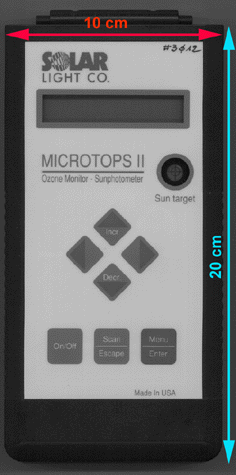
Microtops II sensor manufactured by Solar Light Company
of Philadelphia. This instrument measures the thickness of the ozone layer by computing
the ratios of UVB irradiances measured at three different wavelengths; the water vapour content of the
atmosphere and the AOT (aerosol optical thickness) are also measured by the instrument.
The measurement results are given in DU (Dobson Unit). 100 DU correspond to a total
thickness of 1 mm, if the ozone layer were at a standard atmospheric pressure of 1013.25
[HPa]. Common values are in the 250..350 DU range.
The previous years dobsonyy.html files and the Microtops measurement files can be found in the data area!
Attention: blue lines correspond to
measurements done using instrument #3012 (operator Mike Zimmer). The data in the
table are the original readings multiplied by the calibration factor 0.908658
(new calibrated instrument_5375 = 0.908658*instrument_3012)
. Comparison tests made from 15Sep to 02Oct 2009.
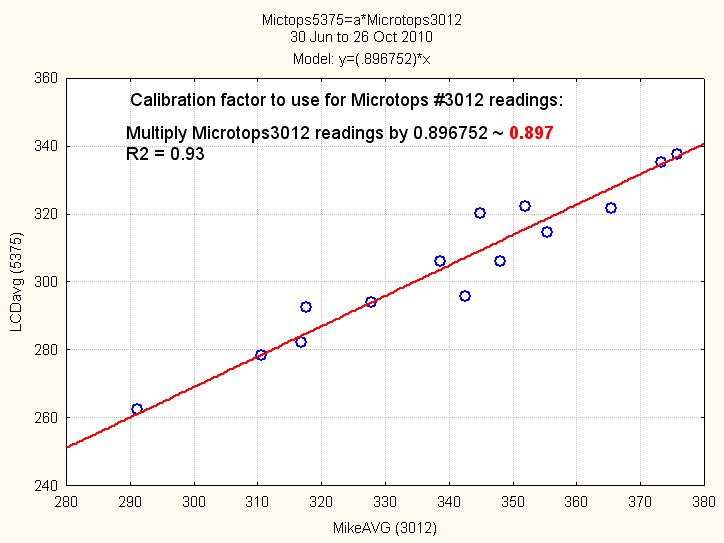
Starting 9th Nov.2010, the calibration factor 0.897 will be used, based on a
comparison from 30Jun to 26Oct 2010 (14 days of neraly simultaneous
measurements). See calibration graph
here. A linear fit
not forced through the origin gives no better result (same R2).
Starting 15 Sep 2009, Microtops #5375 is back from
calibration at Mauna Loa. Purple data correspond to the new calibrated readings.
There is a big difference between the readings before and after calibration. For
some time, measurements will be made with both Microtops, and a conclusion drawn
thereafter.
Back to Home ............................................Please send all mail to francis.massen@education.lu